
A good sex doll cannot be judged from a product photo alone. Material, finish, joints, connections, packaging and traceability all need to be right. We therefore use three control stages and record every deviation in our quality management system.
Three controls with separate purposes
1. During production. Factory staff inspect parts, finish and assembly while products are being made, so issues can be corrected before packing.
2. After production, before shipment. An independent inspection company selects random cartons from the finished batch and reports measurements, tests, photographs and findings.
3. On arrival. We perform our own sample checks. Any product with damaged or unusual packaging is always opened and inspected in full.
What the independent inspection checks
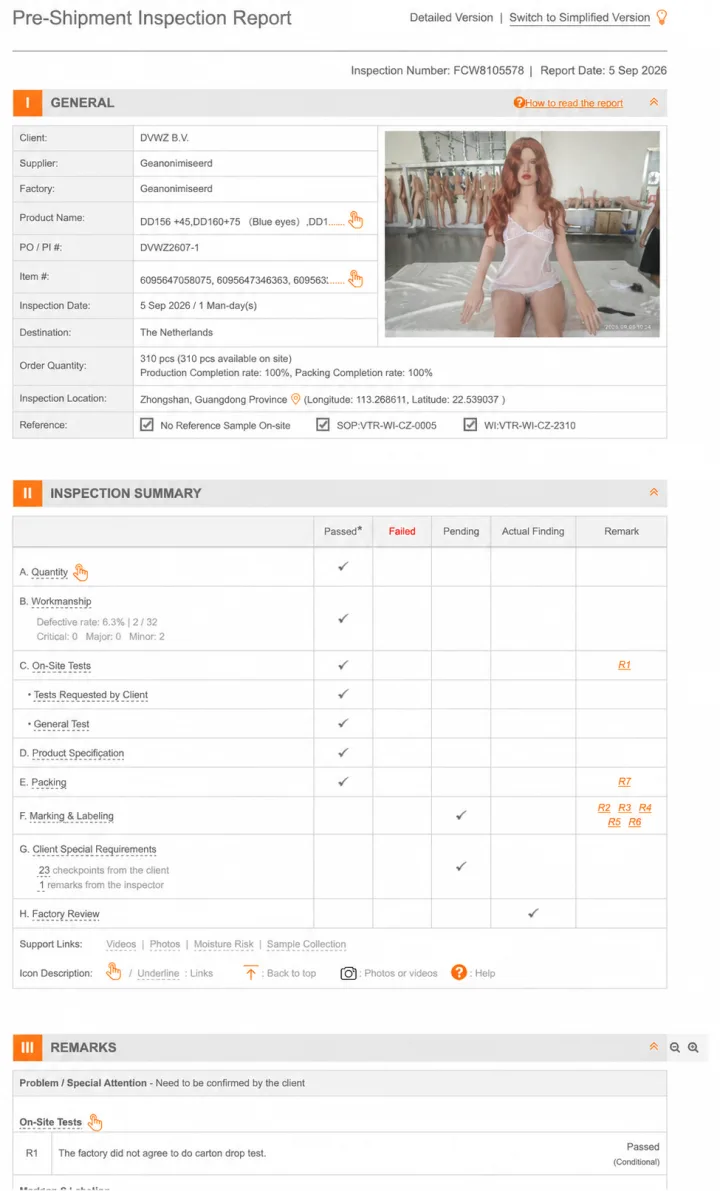
The attached inspection covered a batch of 310 products and a workmanship sample of 32 randomly selected units. Sampling followed ISO 2859-1 and AQL limits for critical, major and minor defects.
- TPE and silicone surfaces, tears, thin spots, marks, glue residue and colour;
- facial make-up and eyebrow attachment;
- full and smooth joint movement plus 50 bending cycles on load-bearing joints;
- pull strength and condition of the head connection;
- dimensions, weight, model details and supplied parts;
- odour, barcodes, manuals, labels and traceability;
- protection of the head, hands, neck and feet and the export carton.
Findings are not hidden
The report recorded two minor cosmetic defects, open points concerning batch identification and documentation, and a carton drop test that the factory did not agree to perform. These points are classified, fed back and followed up before release or in the next production cycle. A “pending” conclusion means that the buyer must assess open points; it is not the same as a failed batch.
A closed improvement loop
Every deviation receives a category, severity and owner. Together with the manufacturer we determine the cause, corrective action and verification for the next delivery. We combine production data, independent reports, incoming checks, return reasons and customer feedback. More than ten years of experience tells us where to look especially closely: moving skin areas, fingers and nails, joints, head connections and transport protection.
Damaged packaging receives a full check
Packaging damage does not necessarily mean product damage, but it always triggers a full inspection. We check pressure points, protective materials, head, hands, feet, skin and joints before the product can be released.
Why we trust this method
No sampling system can promise that nothing will ever deviate. Three independent control moments and a documented improvement cycle do, however, reduce risk and make every signal useful. We are convinced this method enables us to offer the best quality in the market.